
Soft Tissue, Aesthetics and Teamwork Take Centre Stage at the AID my Generation Symposium 2026 (english version)
Zurich, 21 May 2026 – “Pink. White. Wow. – Shaping soft tissue. Perfecting crowns. Winning as a team.” Under this year’s motto, the AID my Generation Symposium brought together three presentations that perfectly reflected the core themes of modern implant dentistry. While Dr Kai Fischer focused on soft tissue management around implants, PD Dr David Schneider explored the key factors behind aesthetically and functionally successful crown restorations. Together with dental technician Daniel Pally, he also highlighted why close collaboration between clinicians and laboratories has become more important than ever.
Why Soft Tissue Matters
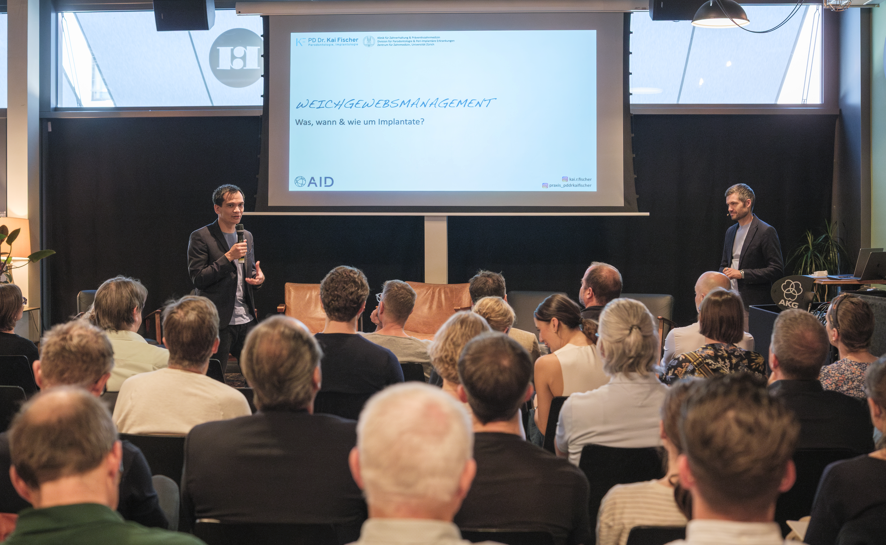
In his lecture, “Soft Tissue Around Implants – Graft or Not, Which Techniques, and How to Uncover?”, Dr Kai Fischer emphasized the crucial role soft tissue plays in ensuring the long-term success of implant restorations. His central message was clear: focusing solely on hard tissue is no longer enough.
Drawing on a range of clinical case studies, Fischer demonstrated the importance of strategic soft tissue management. He presented different surgical approaches for soft tissue augmentation and implant uncovering, discussing techniques including the Palacci technique, roll flap procedures, and the meander technique developed by Arndt Happe and Gerd Körner.
He also explored various donor sites for connective tissue grafts, comparing clinical experience with findings from the scientific literature. His presentation illustrated how both the choice of graft material and the surgical technique can significantly influence long-term stability and aesthetic outcomes.
To conclude, Fischer addressed the question many clinicians continue to ask: what is the gold standard for soft tissue management around implants? After comparing different materials and treatment approaches, he shared his own conclusion: connective tissue grafting combined with a coronally advanced flap remains one of the most predictable and reliable solutions available today.
Defining the Perfect Crown
The second lecture saw Dr Schneider tackle an apparently simple question: what exactly makes a “perfect crown”? As he demonstrated, the answer is far more complex than it first appears.
Every clinical situation is unique, meaning a crown can never be evaluated in isolation. Factors such as symmetry, neighboring teeth, contralateral structures and functional integration within the existing dentition all contribute to the final result, alongside purely aesthetic considerations.
Equally important, Schneider noted, is the patient’s perspective – an aspect that is often overlooked when clinicians focus too heavily on what is technically achievable rather than what the patient actually wants.
He also examined how aesthetics can be assessed objectively. Referring to established evaluation systems such as the Pink Esthetic Score (PES, according to Fürhauser et al.) and the White Esthetic Score (WES, according to Belser et al.), Schneider showed how clinicians can systematically evaluate both crown appearance and surrounding soft tissue conditions. At the same time, he cautioned against relying too heavily on such scoring systems, noting the limitations in their reproducibility.
According to Schneider, careful treatment planning remains the foundation of successful outcomes. Technologies such as guided implant surgery and computer-assisted planning now allow clinicians to create ideal restorative conditions much earlier in the treatment process. However, he stressed that reconstructing hard and soft tissue deficiencies remains highly challenging, and that complete reconstruction is not always possible.
Success Depends on Collaboration
In the final part of the symposium, Dr Schneider and dental technician Daniel Pally shifted the focus to one of the profession’s most important topics: collaboration between practice and laboratory.
Both speakers demonstrated how digitalization has fundamentally transformed communication workflows and opened new possibilities for diagnostics, treatment planning and interdisciplinary cooperation. Digital photography, intraoral scanning, 3D imaging and advanced planning software now enable faster and far more comprehensive information exchange than ever before.
At the same time, both speakers emphasized that digital tools alone do not guarantee successful outcomes and that even the most advanced technology has its limitations in certain clinical situations.
Pally highlighted the importance of involving dental technicians as early as possible in treatment planning. The better technicians understand both the clinical starting point and the intended treatment goals, the more effectively they can develop precise technical solutions.
For that reason, both speakers strongly advocated an interdisciplinary approach in which digital and analogue methods are intelligently combined, allowing dentists, dental technicians and patients to work together as one team from the very beginning.
The Takeaway: Biology, Planning and Communication
Although the presentations focused on different aspects of implant dentistry, all three delivered the same overarching message: long-term success in implant therapy is never the result of individual treatment steps alone, but rather the combination of sound biological principles, meticulous planning and close interdisciplinary collaboration.
Whether discussing soft tissue management, crown design or digital workflows, the ultimate goal remains unchanged – delivering stable, functional and aesthetic outcomes that truly benefit the patient.
Autor: Dr. Anna Stelling-Germani