New approach to implant overdentures honored with AID Practical Impact Award (english version)
Award winner Dr. Sabrina Maniewicz shares her perspective on the c-SIMO concept and its impact on patient care
Zürich, October 2025 – The Alliance for Implant Dentistry (AID) has recognized outstanding clinical research with its Practical Impact Award 2025, honoring Dr. Sabrina Maniewicz for her pioneering work on the canine-positioned single implant mandibular overdenture (c-SIMO).
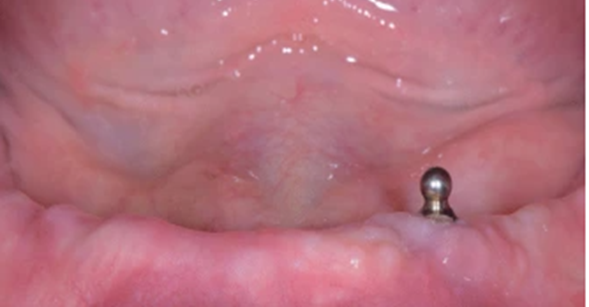
Her multi-center pilot study explored whether placing a single implant in the canine region on the patient’s preferred chewing side could serve as a viable alternative to the conventional midline placement. The results after one year were encouraging: In 15 participants, implant survival was reported as 100%, patients experienced clear improvements in oral health-related quality of life and satisfaction, and prosthetic complications remained low.
Dr. Maniewicz emphasizes that the idea was inspired by the everyday challenges faced by elderly and edentulous patients:
Dr. Sabrina Maniewicz
The interest in single implant mandibular overdentures (SIMO) stems from daily experience with older patients. Many edentulous patients today receive their first complete dentures later in life, often with poorer health and limited financial resources. While the standard two-implant overdenture is effective, it can be too invasive or costly for some. SIMO offers a less invasive, more affordable alternative that could improve treatment acceptance.
The c-SIMO approach adapts an existing treatment concept by moving the implant from the midline to the canine region. This subtle shift could translate into meaningful clinical benefits:
“Our work aims to further improve existing treatment concepts, in this case by lateralizing the implant from the midline to the canine region on the preferred chewing side (c-SIMO). This position offers potential advantages: the implant support is closer to the masticatory center which could potentially improve chewing efficiency, the prosthetic components are placed in an area where there is more prosthetic volume available which should reduce fracture risk, and finally, it enables the flexibility to add a second implant later, reverting to the standard two-implant approach if it is ever needed. C-SIMO could improve efficacy while preserving affordability, thereby enhancing patient acceptance.” Dr. Sabrina Maniewicz
While the early data is promising, Dr. Maniewicz is cautious not to overstate the findings and underlines the importance of ongoing research:
“The c-SIMO approach is still relatively new compared to midline-SIMO or two-implant overdentures. Larger, long-term studies are required to confirm its performance. We are currently pursuing this research and hope to share results in the coming years.” Dr. Sabrina Maniewicz
The AID research commission recognized this study for its originality, its high methodological quality, and especially its practical relevance for clinical implantology. With the Practical Impact Award 2025, AID congratulates Dr. Maniewicz and her team on their achievement and also thanks all researchers who submitted their work for this year’s award.
Dr. Maniewicz’s work on c-SIMO is a compelling example of science with practical impact — offering a treatment option that balances efficacy, affordability, and accessibility, and that has the potential to improve quality of life for older patients worldwide.
Autor: Dott.ssa Anna Stelling-Germani
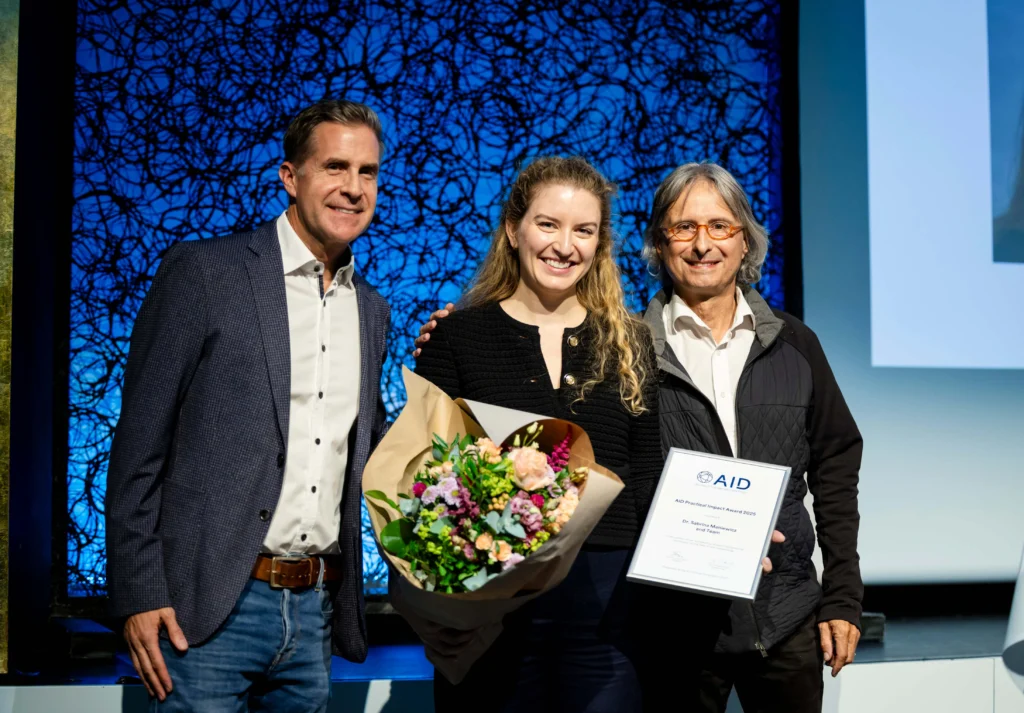
Image: Award ceremony at the general meeting in October 2025 | From left to right: Christian Ramel, Sabrina Maniewicz, Konrad Meyenberg